








Bavarians, Mining, and “Broschglt”
Albert Pfeifer, who grew up at the Spörlhof farm and spent many years teaching in Deutschnofen/Nova Ponente, knows the village's stories well.
“Deutschnofen is a special place for me,” says Albert Pfeifer. He is deeply rooted here—not only because he can look back on a long family history at the Spörlhof on the western edge of the village, but also because he spent most of his professional life here, teaching at the Deutschnofen elementary school until his retirement in 2009. “This is my home,” he says. And he knows it well, not only due to his profession, but also because he has studied the village's history and its unique features with great interest.
Today, Deutschnofen, with its roughly 4,000 residents, is a modern tourist destination with strong infrastructure. Comfort and prosperity—hallmarks of the past few decades—were anything but normal throughout most of the village's long history. “Life in the mountain village of Deutschnofen was hard,” recalls Albert Pfeifer. He remembers seeing the old farmer from Nopphof transporting valuable wood from the Eggental valley down to the valley floor with an ox cart for trade. And how he would climb back up from Leifers/Laives via the steep and lengthy Sissatal trail to the Wölflhof and then back to the Nopphof with “Broschglt”— Deutschnofen’s dialect word for grape mash. “He usually drank the wine he made from it himself,” Albert Pfeifer says with a smile.
„As a student, I practically walked the distance from home to Berlin eight times“
As a child, Albert Pfeifer quickly learned that life on a mountain farm was no picnic. He and his six siblings were expected to work hard: guiding the cows into the forest and keeping watch over them. And when school called, the alarm rang at 5:30 AM—six kilometers on foot in all weather, and the same distance back at three in the afternoon. “As a student, I practically walked the distance from home to Berlin eight times,” says Albert Pfeifer. “Today, that’s hard to imagine.”
Still, his generation experienced relatively good times. Life has always been tough up here on the plateau between 1,360 and 1,500 meters above sea level. In poor summers, when crops didn’t ripen, many suffered hunger—but despite the harsh conditions, early settlements sprang up here, laying the foundations for today’s Deutschnofen.

There is evidence—though limited historical documentation—that people lived on the plateau even before the birth of Christ. It’s believed the first settlers lived where the Spörl and Nopphof farms now stand, in the Manée district, which likely existed long before today’s Deutschnofen. These settlers were of Celtic, Lombardic, Etruscan, or Illyrian origin. The Romans referred to them as Rhaetians, the general name for Alpine mountain dwellers, and named a Roman province after them: Raetia, which spanned much of the Alps. One legacy of the Rhaetians lives on in the region: the Rhaeto-Romance Ladin language, still actively spoken in valleys such as Val Badia, Val Gardena, and Val di Fassa, and recognized alongside Italian and German as an official language.
The name “Deutschnofen,” however, only emerged after the fall of the Roman Empire. The Bavarians, who entered the region through the Pustertal valley, were said to have an insatiable hunger for land. They cleared forests in higher elevations to cultivate new terrain. First documented in 1150 as “Nova” (meaning “new land”), the village eventually became known as “Nova Teutonica,” referring to the origin of its new inhabitants. “Nova Teutonica was a typical Bavarian settlement,” explains Albert Pfeifer—with a small village center and numerous widely scattered farms.

First mentioned as a parish in 1265 and as a court seat in 1272, Deutschnofen has always been shaped by its geographic peculiarity: the plateau is cut off from its surroundings in nearly every direction. Travel to and from the village was always arduous, involving long and strenuous treks on foot. The inhabitants were self-sufficient farmers—facing all the challenges of life at over 1,300 meters. Trade was mainly in wood, which they hauled with ox carts through the Brantental valley to the Etsch/Adige River, where it was floated south on rafts. “Some of the grand buildings in Venice—and even the Vatican—are said to have used wood from Deutschnofen,” says Albert Pfeifer. The timber was also highly valued for fuel, construction, and viticulture. Additionally, the resonant wood of old spruces from the Eggental valley was famed for violin making—so much so that the legendary luthier Antonio Stradivari is said to have selected wood for his violins from the forests around Latemar. Today, around 650 Stradivari instruments survive—some valued in the millions.
Mining was another source of income around the 15th century, especially in the west toward the Brantental valley, where fluorite was extracted. The mining heritage is still visible in the two churches of St. Helena and St. Agatha. “They were ‘miners’ churches’,” says Albert Pfeifer, “built for those engaged in the harsh mining work.” These churches are well worth a visit—particularly for their beautifully preserved frescoes.
Also worth seeing is the parish church in the village center, consecrated in 1498. Its centerpiece is a valuable altar created around 1422 by Hans von Judenburg. Originally intended for Bozen/Bolzano’s city church, it found its home in Deutschnofen when, in 1724, Bozen/Bolzano’s city council deemed it outdated and gave it away.
The church’s consecration occurred during a period when the plague was rampant. Just how badly Deutschnofen was affected is unclear today. A legend tells of a girl from the Tschufflerhof farm as the only survivor in the village. This likely isn’t historically accurate—but the “Black Death” devastated many farms, if not wiping them out entirely. The widespread belief that working at night would avoid infection proved fatal in too many cases.

Far more clearly documented—and equally impactful—were the two World Wars of the 20th century. “There isn’t a single family that hasn’t been affected,” says Albert Pfeifer. An entire generation of young men was lost, many never returning from the front. The military confiscated livestock to feed soldiers, church bells were melted down for cannons, and women left behind had to manage the farms—or what was left of them—on their own.
But even after World War I ended in 1918, hardships continued. South Tyrol became part of Italy in 1919, and when Mussolini’s Fascists rose to power, everything reminiscent of German-speaking heritage and tradition was banned. Children were forced to attend Italian schools, local administrators were sent from other parts of Italy, and speaking German was officially forbidden. “So-called catacomb schools were formed, where farm children were secretly taught in German,” says Albert Pfeifer. Still, mistrust ran deep in the village—no one knew whether their neighbor supported the Fascists. The darkest moment came in 1939, when all South Tyroleans were forced to choose: emigrate to the German Reich or stay in Italy. Families were often torn apart, and many were forced into a new homeland.
With the onset of World War II that same year, the situation worsened. One of Albert Pfeifer’s own family experiences highlights how surreal life became: his father was first deployed by the Italian army near Naples, then, after Nazi Germany took control of South Tyrol, was drafted into the German army and sent to fight in Poland—eventually ending up in Russian captivity.
Others tried to avoid military service by hiding in forest huts. “Of course, they were hunted,” says Albert Pfeifer. Their families were pressured to betray them—with harsh consequences: “I know of a family where the mother and daughter were arrested and sent to a concentration-camp-like facility in Bozen/Bolzano.” Although phosphorous bombs caused major fires near the Titschenwarte in western Deutschnofen - where anti-aircraft guns were stationed—the village itself remained largely unscathed by the war.
Nevertheless, it took a long time to recover from the war’s effects and find a place in postwar Italy. Although local politics in Deutschnofen remained rooted in South Tyrolean identity (except during the Fascist period), the autonomy statutes of 1948 and 1972—and their implementation—were vital in preserving that identity. “Today, Europe’s borders are open,” says Albert Pfeifer. “In peaceful times, it doesn’t much matter which country we belong to.”

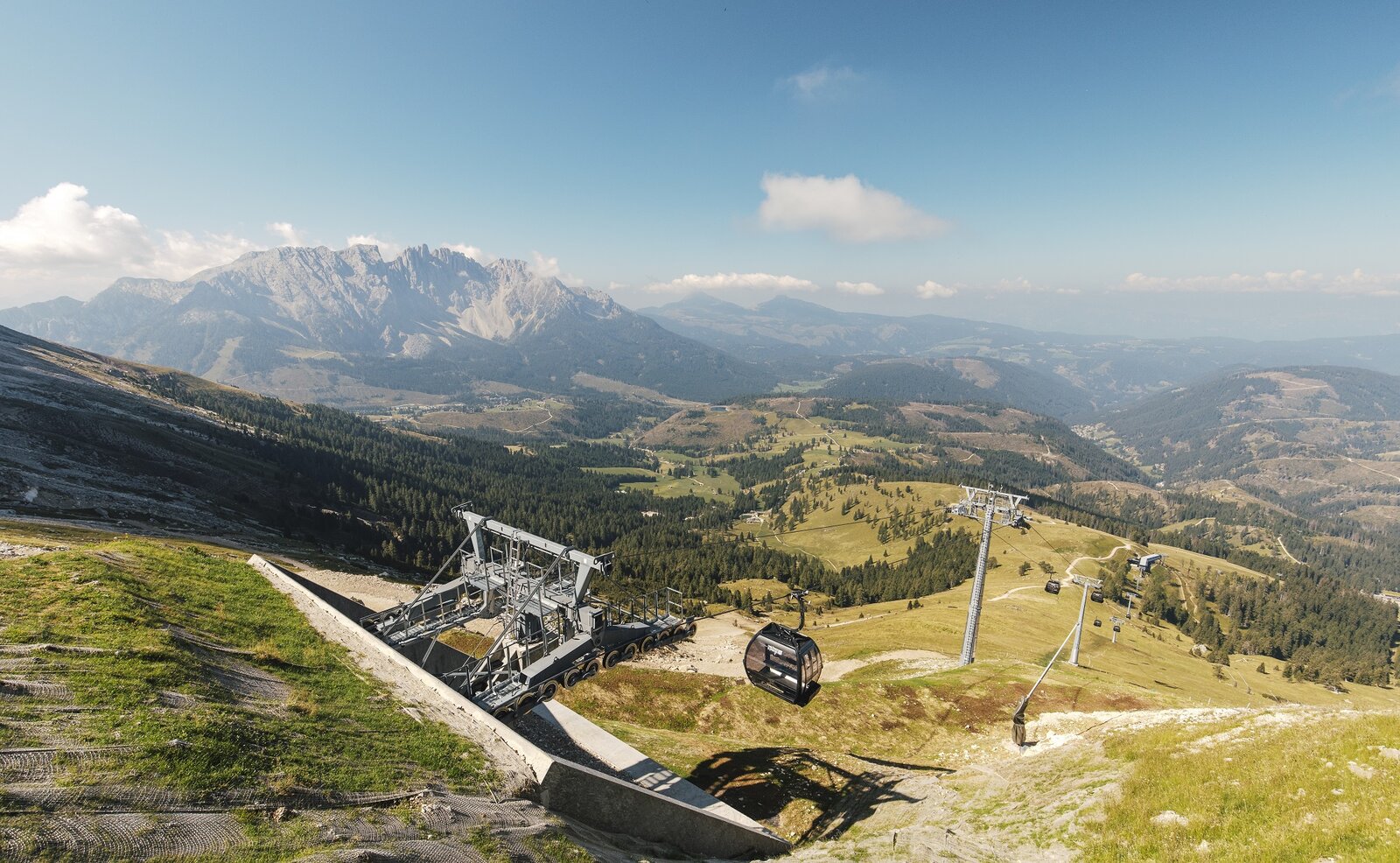
Today, people from all over the world come to Deutschnofen to spend their holidays—the best time of the year. Initially, tourism here was just a fragile seedling. Until the 1960s, there were only a few inns—like the Stern or Rösslwirt in the village center. But everything changed quickly with the opening of the Obereggen ski area in 1972. “That’s when my mother started running a farm holiday business at Spörlhof,” recalls Albert Pfeifer. “She was the eleventh person in all of South Tyrol to try it.” Today, there is a wide variety of accommodations in Deutschnofen - from simple holiday apartments to hotels offering every comfort.
Now retired, Albert Pfeifer enjoys the beauty of his homeland with his wife. He remains interested in Nova Ponente’s history and helps maintain and mark hiking trails. The Spörlhof farm where he grew up is now run by his brother and his family—and still welcomes many holiday guests.

“It’s almost like standing on a mountaintop here,” he says as he gazes across the landscape. Even in sun-drenched South Tyrol, Deutschnofen’s plateau is among the sunniest places. Though its geographical isolation has lost significance thanks to modern infrastructure and mobility, it still preserves a distinct local dialect. “Ours is one of the quirkiest dialects in all of South Tyrol,” says Albert Pfeifer. While most people say “dahoam” (at home), in Deutschnofen, it sounds a little different—“dahaam.” And when Albert Pfeifer hears that, it’s another reason why he feels at home. Here, in this very special place—not only for him.


